
How to get over jet lag is a question that has followed long-distance travelers since commercial jet travel became widespread in the 1960s. Today, with roughly 1.5 billion international arrivals recorded in 2019 alone according to the CDC Yellow Book, jet lag is arguably one of the most common physiological disruptions on the planet. And yet, most people still address it with guesswork, drinking an extra coffee, napping at the wrong time, or simply suffering through it.

Before getting into what works, it helps to understand precisely what you are trying to fix. Jet lag is a circadian rhythm sleep disorder caused by rapid crossing of time zones, leaving your internal biological clock misaligned with the local environment. Your master clock, a cluster of roughly 20,000 neurons called the suprachiasmatic nucleus (SCN) in the hypothalamus, runs on an approximately 24-hour cycle and is primarily reset by light. Peripheral clocks in your gut, liver, lungs, and muscles run on related but separate schedules.
When you land in a new time zone, the SCN begins the process of re-entraining to local light and darkness cues. But it can only shift by about one to one-and-a-half hours per day on its own. That natural rate is why jet lag lingers for days rather than resolving overnight. Every strategy covered in this article works by either speeding up that re-entrainment process or managing symptoms while the clock catches up.
The key insight from a landmark NIH-funded research paper on avoiding jet lag is that light and melatonin are the two most powerful tools for resetting the circadian clock, and their effects depend critically on timing. Getting the timing wrong on either one can shift your clock in the wrong direction and actually extend your jet lag rather than shorten it. This is why a random melatonin pill at the wrong hour does more harm than good.
Most travelers board their flight having done nothing to prepare their biology for the shift ahead. This is a missed opportunity. Two to three days of pre-travel preparation can meaningfully reduce the severity of jet lag at the destination and compress recovery time. The CDC specifically recommends beginning to adjust your body clock to the destination time zone a few days before departure.
The most evidence-backed pre-travel strategy is gradually moving your bedtime and wake time toward destination time before you leave. For eastward travel, go to bed and wake up one hour earlier each day for two to three days before departure. For westward travel, shift one hour later each day. A peer-reviewed clinical trial published in PMC funded by the NIH found that a gradually advancing sleep schedule combined with morning bright light produced median circadian phase advances of 1.4 to 1.9 hours over three days, meaning travelers arrived already partially adjusted to the new time zone.
Even partial pre-adjustment is valuable. If you are crossing six time zones eastward and your clock is already two hours advanced before you board, you are starting from a deficit of four hours instead of six. That is potentially two fewer days of jet lag.
The same NIH-funded study found that short bursts of bright light in the morning, even as little as 30 minutes of approximately 5,000 lux upon waking, are effective at advancing circadian rhythms when combined with a gradually earlier sleep schedule. You do not need expensive equipment for this: going outside within 30 minutes of waking and spending time in natural sunlight on the days before an eastward flight is the simplest and most powerful version of this strategy. Outdoor sunlight ranges from 10,000 to 100,000 lux, far more intense than any indoor light source.
This sounds simple, but it has genuine scientific backing. The Sleep Foundation notes that poor sleep in the days leading up to travel increases susceptibility to jet lag and extends recovery. Your circadian system is more resilient and adaptive when it starts from a position of adequate sleep. Traveling while sleep-deprived means you are fighting jet lag from a deficit, and every extra hour of sleep debt adds another layer of disruption to an already disrupted clock.
If you have ever had a frantic last night before a big international trip, with last-minute packing, a late goodbye dinner, and barely four hours of sleep before a 5 a.m. departure, you have already experienced the price of starting a long journey depleted. Veteran travel writer Rick Steves, in his jet lag guidance, puts it simply: leave home well rested. The first days of a trip are hard enough on the circadian system without beginning them in sleep debt.
The flight itself is not dead time when it comes to jet lag recovery. Your behavior in the air, what you eat, drink, when you sleep, and how you manage light, sets up either a smoother or harder landing.
The moment you board, set your watch and phone to destination time. This is a behavioral anchor that primes your decisions throughout the flight. The CDC recommends following the sleep and waking routines of your destination as soon as you arrive, and beginning that mental shift at boarding makes it easier. If it is nighttime at your destination, make every effort to sleep on the plane, even if it is afternoon by your body’s current schedule. If it is daytime at your destination, resist the urge to sleep for long stretches.
Light is the most powerful signal your circadian clock receives, and the plane environment gives you more control over it than most people use. If you are flying eastward and you want your clock to advance, use a sleep mask and close the window shade during the later portion of the flight to avoid early light exposure that would shift your clock in the wrong direction. When it is morning at your destination, accept light exposure. National Geographic’s travel team cites Stanford sleep researcher Jamie Zeitzer on the power of even small changes in light environment: anything you can do to get comfortable enough to sleep can have a very strong effect.
Airplane cabin humidity is typically below 20 percent, which is significantly drier than most desert environments. This promotes dehydration, and dehydration amplifies the physical symptoms of jet lag, including headache, fatigue, and brain fog. The CDC Yellow Book clinical guidance specifically notes that volume depletion worsens jet lag’s physical symptoms and recommends staying well hydrated. The Aerospace Medical Association suggests at least eight ounces of water per hour in the air as a reasonable hydration target.
Alcohol is a different story entirely. While it may seem to ease sleep onset on a long flight, it significantly disrupts sleep architecture, reducing the restorative quality of sleep and fragmenting the sleep cycle. A PMC review on jet lag and athletes confirms that alcohol and caffeine both act as diuretics, compounding dehydration, and that limiting both during flight reduces jet lag severity. One drink will not ruin your flight, but drinking through a long haul is a reliable way to arrive feeling worse and recover more slowly.
Your gut has its own peripheral clock, and feeding times are one of its primary zeitgebers, the technical term for time cues that reset biological clocks. Eating meals that correspond to the meal times of your destination rather than your departure time zone sends early re-entrainment signals to digestive tissues. The CDC recommends eating smaller meals specifically to reduce the gastrointestinal distress that is a common jet lag symptom. Airline food served on the plane’s own schedule may not align with your destination’s optimal meal times, so it is worth declining the tray if the timing is working against your adjustment.
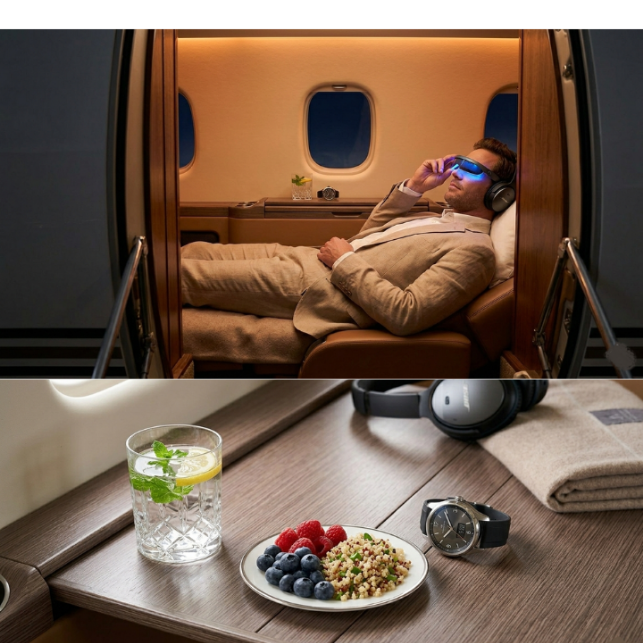
Sleeping on the plane when it is nighttime at your destination does double duty: it reduces your sleep debt before landing, and it begins behavioral alignment with the new time zone. A PMC research review on jet lag therapies notes that getting quality sleep on the flight is one of the most reliable ways to reduce post-arrival fatigue, independent of circadian resetting. The challenge is making sleep possible. Bring a good neck pillow, noise-canceling headphones or earplugs, an eye mask, and set the seat temperature to cool. A cool, dark, quiet environment produces better sleep regardless of altitude.
Long-haul flights involve hours of near-total immobility. Standing up and walking the aisle regularly maintains circulation, reduces muscle stiffness, and lowers the risk of deep vein thrombosis. From a jet lag standpoint, movement also helps manage the general malaise and physical discomfort that compound the sense of jet lag symptoms. In a survey of 460 long-haul travelers cited in the CDC Yellow Book, 35 percent reported periodic aisle-walking as one of their jet lag management strategies.
The first 48 hours after landing are when your choices matter most. This is the window where the right actions can compress your recovery timeline and the wrong ones can add days to it. The temptation to nap immediately upon arrival is the single most common mistake that extends jet lag unnecessarily.
This is the hardest advice to follow and one of the most important. Arriving after a long overnight flight with only a few hours of broken sleep, the urge to lie down and sleep for three to four hours is overwhelming. Resist it. A long nap at the wrong time reinforces the old time zone’s sleep schedule and anchors your circadian clock to your departure time zone, making the total adjustment take significantly longer.
If you are genuinely unable to stay awake, limit yourself to a 20 to 30 minute nap, set an alarm before lying down, and make yourself get up when it goes off. The CDC recommends naps of no more than 15 to 20 minutes during the day, which are long enough to reduce acute sleep pressure without disrupting nighttime sleep. A PMC review on AASM circadian rhythm guidelines confirms that 20-minute naps improve alertness without producing sleep inertia or interfering with the main sleep period.
Sunlight is your most powerful tool after landing. The Sleep Foundation names light as having the biggest influence on circadian rhythm of any environmental factor. Getting outside within the first hour of arrival, even for a 20 to 30 minute walk, exposes your SCN to the local light-dark cycle and begins the re-entrainment process in earnest.
The timing of this light exposure matters. For eastward travel, afternoon light at the destination is the most helpful for advancing your clock. For westward travel, morning light is key. Research cited by Rise Science found that travelers who stayed inside their hotel rooms after arrival took four to six days longer to adjust than those who went outside and engaged with the local environment. The cost of a 30-minute walk after landing could be literally days of faster recovery.
This is the other piece of advice that is easy to understand and hard to follow. Your body will likely be telling you it is the middle of the night several hours before local bedtime at your destination. Push through. Going to sleep at 7 p.m. local time because your body says it is midnight back home locks in a disrupted schedule for the next several days.
University Hospitals sleep medicine specialist Dr. Eileen Wong, quoted in the University Hospitals guide on reducing jet lag, recommends planning activities after arrival to avoid the temptation to nap and to help the internal clock adjust. Even something as simple as a walk outside serves this purpose. Keep yourself in motion and in light until local nighttime, then sleep.
Melatonin is the most widely used jet lag supplement, but the vast majority of people who take it do so at the wrong time or dose, reducing its effectiveness significantly. The NIH research review on jet lag explains the phase-response curve (PRC) for melatonin: it produces the greatest phase advances when taken in the afternoon relative to your old time zone (which corresponds to early evening at your destination for eastward travel), and the greatest phase delays when taken in the morning.
For the most common jet lag scenario of eastward travel, taking melatonin 30 to 60 minutes before your intended local bedtime at the destination is the evidence-supported approach. The American Academy of Sleep Medicine (AASM), in its formal practice parameters for circadian rhythm sleep disorders, found that immediate-release formulations in doses of 0.5 to 5 mg may be effective at relieving jet lag disorder symptoms, with 5 mg being only marginally more effective than 0.5 mg in head-to-head comparison.
The practical implication: a lower dose of 0.5 to 1 mg timed correctly is likely as effective as the 10 mg doses many people assume are stronger. Melatonin is not FDA-approved as a drug for jet lag in the United States; it is sold as a supplement. The CDC Yellow Book notes that both the AASM and the National Center for Complementary and Integrative Health suggest it could be used to reduce symptoms, while cautioning about potential interactions with certain medications including those for seizures and autoimmune conditions.
Caffeine is useful for managing jet lag daytime sleepiness, but the timing matters enormously and most travelers get it wrong. A study cited in a PMC review on jet lag heuristics and therapeutics found that 300 mg of slow-release caffeine enhanced alertness in eastward-bound travelers. The Walter Reed Army Institute of Research (WRAIR) jet lag protocols, cited in the CDC Yellow Book, recommend taking caffeine every four hours during daylight hours as needed for alertness, but stopping at least six hours before intended bedtime.
Caffeine’s half-life is approximately five hours, meaning a coffee taken at 3 p.m. still has half its alerting effect at 8 p.m. The circadian experts at Timeshifter, whose app was developed with input from NASA-affiliated researchers, recommend a ‘little and often’ approach: small amounts of caffeine every two hours to maintain alertness rather than large doses that spike and then crash, and stopping early enough to protect nighttime sleep quality. Importantly, while caffeine helps manage symptoms, it does not reset the circadian clock directly. It is a symptom management tool, not a cure.
The timing of meals sends re-entrainment signals to peripheral clocks in the digestive system, which run on a partially independent schedule from the brain’s master clock. Research on athletes cited in PMC confirms that the timing of meals in a new environment is more important than the type of meal for circadian adjustment. Eating at locally appropriate times from the first day at your destination sends consistent zeitgeber signals to the gut clock and supports faster total body resynchronization.
On a practical level, this means eating breakfast at local morning time even if your body is not hungry, having lunch at local noon, and having dinner at local evening rather than eating according to when you feel hungry based on your departure time zone. Some travelers find this difficult, but the CDC recommends eating smaller meals to ease gastrointestinal symptoms during this adjustment period, which makes timing meals at right times less of a physical struggle.
Exercise acts as a secondary zeitgeber that can support circadian adaptation. The CDC’s jet lag management guidance recommends using exercise strategically to stay alert during the day while avoiding it in the evening. The direction-specific principle from circadian research is: for eastward travel, afternoon and early evening exercise at the destination helps advance the circadian clock. For westward travel, morning exercise is more useful.
Exercising outdoors combines light exposure with physical activity and is arguably the most efficient single recovery action available after landing. A 30-minute walk or run outside in the afternoon on the first day after an eastward flight hits three targets simultaneously: it exposes you to afternoon light, it raises your alertness through endorphin release, and it helps drive homeostatic sleep pressure that will make sleeping at local bedtime easier that night.
One caution from the PMC athlete research: on the first two to three days after eastward travel, avoid morning exercise, as morning activity combined with morning light at the wrong phase of your clock can shift your rhythm in the wrong direction and extend your adjustment period.
When local bedtime arrives, give your body every advantage. The Healthline guide on getting over jet lag recommends checking that the room is dark, that the temperature is cool (research consistently links slightly cool room temperatures to faster sleep onset), and that you have removed sources of noise or unexpected light. A white noise app or portable fan can help mask unfamiliar hotel sounds.
Crucially, put your phone away at least 30 to 60 minutes before local bedtime. Screens emit blue light that suppresses melatonin production, actively working against the hormone your body needs to signal sleep readiness. If you have been careful about light exposure and melatonin timing all day, undermining it in the last hour before bed by scrolling your phone defeats much of the benefit.
A 2021 German study cited in National Geographic found that worrying about having jet lag actually made it worse, amplifying a nocebo effect where anxiety about symptoms intensified their severity. Creating a calm, prepared sleep environment and approaching the first nights in a new time zone with acceptance rather than frustration genuinely helps the process.
A huge number of jet lag remedies circulate among travelers that have no circadian science behind them. Here is a direct comparison of popular beliefs versus what research actually shows.
The Claim | What Research Actually Says |
Drinking water cures jet lag | Hydration reduces physical symptoms and makes you feel better, but does not reset the circadian clock. Timeshifter and circadian researchers are clear that water does not address the underlying cause. Stay hydrated, but do not confuse symptom relief with cure. |
A big coffee will fix you up | Caffeine manages daytime sleepiness symptoms but does not shift the circadian clock. Taken too late in the day, it actually extends jet lag by disrupting nighttime sleep quality. CDC WRAIR protocols recommend stopping caffeine at least 6 hours before bedtime. |
Melatonin at any time helps | Melatonin taken at the wrong time can shift your clock in the wrong direction and extend jet lag. Timing is everything. For eastward travel, early evening at destination. Morning melatonin delays the clock, which is counterproductive when flying east. |
Napping cures jet lag exhaustion | Long naps reinforce the departure time zone and consistently extend recovery. The CDC and AASM research both support naps of 15 to 30 minutes maximum. Anything longer locks in the wrong schedule. |
Fasting before a flight resets your clock | The Argonne fasting diet has been used with some success in military contexts, but evidence in non-military civilian populations is limited. Meal timing upon arrival is supported; pre-flight fasting has weaker evidence. CDC notes formal trials are lacking. |
A glass of wine helps you sleep on the plane | Alcohol reduces sleep latency (time to fall asleep) but significantly fragments sleep architecture, reducing restorative sleep quality. It also dehydrates. CDC Yellow Book specifically recommends avoiding excess alcohol for jet lag management. |
Special diets like high protein or high carb fix jet lag | Some animal studies support high-protein breakfasts for alertness and high-carb dinners for sleepiness promotion. Human evidence is limited. Meal timing upon arrival has stronger support than specific macronutrient composition. |
Because the body adjusts differently depending on which direction you travel, the optimal recovery plan is different for eastward versus westward flights. Here are the key differences.
Because the body adjusts differently depending on which direction you travel, the optimal recovery plan is different for eastward versus westward flights. Here are the key differences.
After deep-diving into all of the research for this article, my honest recommendation is to stop thinking of jet lag recovery as something that just happens to you and start treating it as something you actively manage with a plan. The difference between a traveler who just wings it and one who knows the basics of circadian biology is genuinely two to four days of recovery time on a major long-haul crossing.
If I had to pick three actions from everything in this guide that would give the highest return on the least effort, they would be these: get outside in sunlight within the first hour of landing and stay out for at least 30 minutes. Push through to a reasonable local bedtime on day one, no matter how hard it is. And if you are flying east, take a low-dose melatonin 30 minutes before that local bedtime for the first few nights. Just those three actions, done consistently, will shorten your recovery more than any combination of home remedies, special diets, or expensive supplements.
Jet lag is temporary. Your biology is designed to adapt. Give it the right signals at the right times and it will do the rest.