
How long does jet lag last? It is one of the first questions travelers type into Google before a big international trip, and the honest answer is: it depends. The short version is that most people recover from jet lag within two to seven days, but the full story is shaped by how many time zones you crossed, which direction you flew, your age, your sleep history, and whether you did anything to help your body along the way. Some people shake off a transatlantic flight within 48 hours. Others feel the effects for nearly two weeks.

This article pulls from the most authoritative sources available, including the CDC, Harvard Health, the Sleep Foundation, and peer-reviewed research published through the NIH, to give you a precise, nuanced answer based on your specific travel situation. There are also real-world route examples, a breakdown by traveler type, and the strategies that actually move the recovery timeline forward.
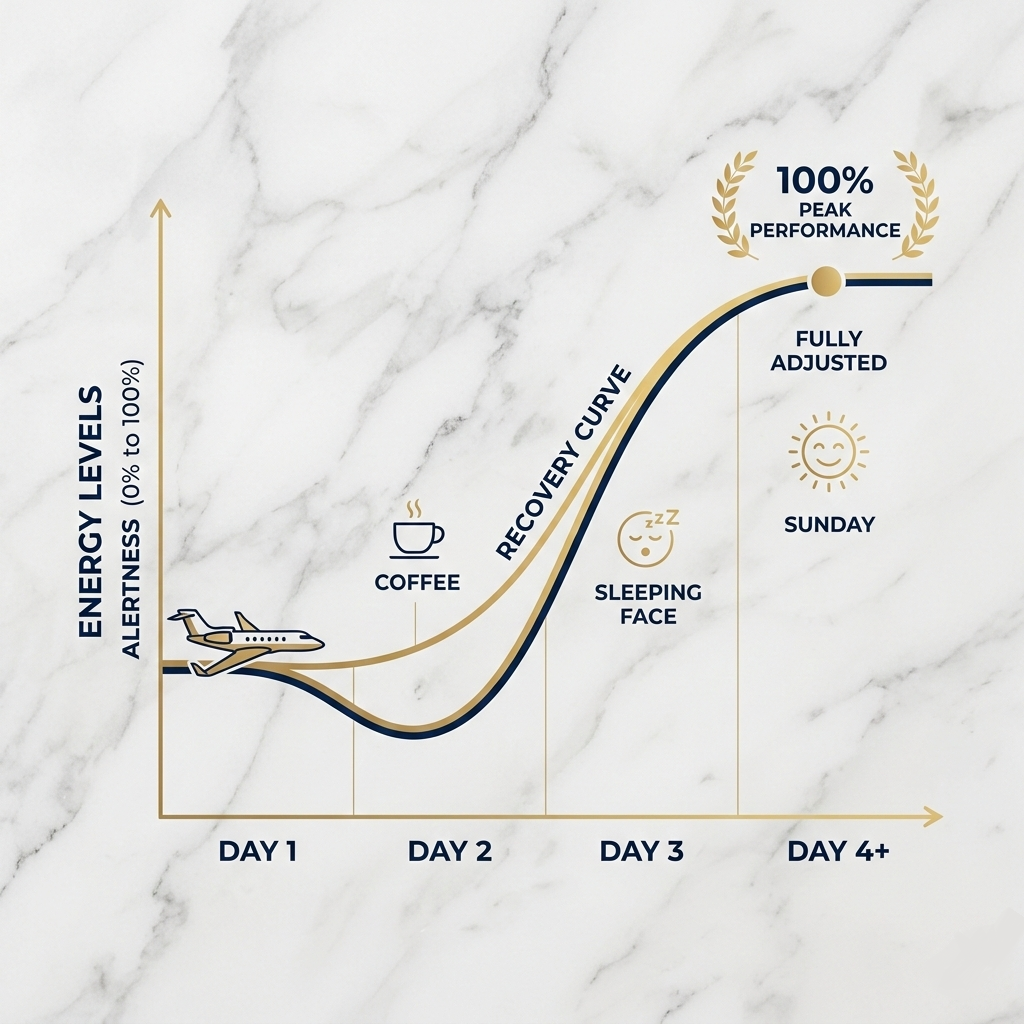
The most widely cited rule across clinical guidelines and research is that the body adjusts to roughly one to one-and-a-half time zones per day. So if you crossed six time zones, you can expect three to six days of recovery under normal conditions. If you crossed ten time zones, recovery could take six to ten days without any deliberate interventions.
According to Harvard Health Publishing, jet lag is a mild problem that goes away on its own within several days for most travelers, and all symptoms should disappear within two weeks even for those who are older or more sensitive to circadian disruption. If symptoms persist beyond two weeks, they recommend seeing a healthcare provider to rule out other causes.
The American Academy of Sleep Medicine (AASM), cited by the Sleep Foundation, confirms that jet lag can last anywhere from a few days to a few weeks, with symptoms persisting for 1 to 1.5 days per time zone crossed on average.
Time Zones Crossed | Typical Route Example | Eastward Recovery | Westward Recovery |
3 | New York to Los Angeles | 3-4 days | 2-3 days |
5 | New York to London | 5-7 days | 3-4 days |
6 | London to Dubai | 5-8 days | 3-5 days |
8 | London to Tokyo | 7-10 days | 4-6 days |
9-10 | New York to Sydney | 7-10 days | 5-7 days |
12+ | US West Coast to India | Up to 14 days | 6-9 days |
The one-day-per-time-zone rule is a good starting point, but it is also a significant simplification. Research from multiple studies and sources confirms that several factors either extend or compress the actual recovery timeline.
Eastward travel consistently produces longer jet lag recovery than westward travel, and the difference is not trivial. Research cited by Rise Science suggests travelers can adjust 30 to 50 percent faster after flying west than east. The reason lies in the fundamental design of the human circadian clock.
The human circadian rhythm runs slightly longer than 24 hours, averaging about 24.2 hours. Because of this, the body naturally finds it easier to extend the day and delay sleep (westward travel) than to shorten the day and advance sleep to an earlier hour (eastward travel). When you fly east, you are fighting the body’s natural direction of drift. When you fly west, you are going with it.
This explains why a New York to London flight (eastward, 5 time zones) typically causes more prolonged disruption than the return London to New York flight (westward, 5 time zones) on the exact same route, same plane, same person.
The more time zones you cross, the longer the recovery. This is the most reliable predictor of jet lag duration. Encyclopaedia Britannica puts it clearly: each time zone crossed represents roughly one day of adjustment, and this is consistent with clinical guidelines from the CDC and AASM. Cross three time zones and most healthy adults are back to normal within three to four days. Cross ten and you are looking at a week or more.
One nuance worth knowing: an important Wikipedia summary of jet lag research notes that research in rodents suggests peripheral organs like the liver, lungs, and muscles can take nearly six times as long as the brain’s master clock to fully resynchronize with the new time zone. This is part of why jet lag can persist in subtle ways, such as digestive irregularity and fatigue, even after sleep feels nearly back to normal.
The research on age and jet lag is genuinely mixed, but the overall pattern points toward older adults experiencing more difficult recovery. A landmark PubMed study on age-related differences in jet lag recovery found that while elderly participants showed fairly rapid adjustment of their circadian temperature rhythm, their sleep disruption and daytime sleepiness were longer-lived and showed little of the recovery over time observed in younger subjects.
A separate study noted that older adults over 60 may produce less regular melatonin rhythms, which weakens one of the body’s key signals for advancing the sleep-wake cycle. This makes light exposure and behavioral strategies even more important for older travelers, since the hormonal reset mechanism is less reliable.
Children, interestingly, often adapt faster than adults. Many parents traveling with young children report that the kids reset within a day or two while the adults are still struggling through the end of the first week.
Arriving at the airport already sleep-deprived makes jet lag significantly worse and extends the recovery window. The Sleep Foundation notes that poor sleep in the days leading up to a flight increases a person’s susceptibility to jet lag after travel. If you are already running a sleep deficit, your circadian system has less resilience to absorb the additional disruption of crossing multiple time zones. This is a factor many travelers never think about but that can add one to two extra days to recovery.
Your natural preference for mornings or evenings affects which direction of travel hits you hardest. Morning types, sometimes called larks, tend to have a harder time with westward travel because delaying sleep is more uncomfortable for them. Evening types, often called owls, have a tougher time with eastward travel because advancing their bedtime to an earlier hour goes against their natural tendencies.
Research cited in Rise Science also found that light exposure was less effective at shifting the circadian rhythm in middle-aged participants compared to younger adults, suggesting that the effectiveness of the primary tool for rapid jet lag recovery also diminishes somewhat with age.
One research finding that tends to surprise people: travelers who stayed inside their hotel rooms after arrival and avoided sunlight and social interaction took four to six days longer to adjust than those who went outside and engaged with the local environment. Light is the single most powerful zeitgeber, or time cue, available to the circadian clock, and hiding from it after arrival is one of the most reliable ways to extend your jet lag unnecessarily.
Both alcohol and caffeine disrupt recovery in ways that travelers consistently underestimate. Alcohol may cause drowsiness but significantly degrades sleep quality, reducing the restorative function that helps the circadian clock reset. Caffeine taken at the wrong time, particularly in the evening local time, can keep the clock from receiving the darkness signals it needs to advance into the new time zone. According to survey data cited in the CDC Yellow Book, 81 percent of long-haul travelers use caffeine or alcohol during flights, often in patterns that extend rather than shorten their jet lag.
Rather than staying abstract, here is a practical breakdown of how long jet lag typically lasts on common international routes. These estimates assume natural recovery with no specific interventions and are based on the one-day-per-time-zone framework adjusted for direction.
This is one of the world’s highest-volume long-haul routes and one of the most studied in terms of jet lag. Travelers typically cross five time zones going east. Most healthy adults report full adjustment in five to seven days without deliberate strategies. With preparation, this can be cut to three to four days. The overnight flight structure, usually departing late evening and arriving early morning local UK time, often leads people to believe they have escaped jet lag on the first day because fatigue carries them through to a relatively normal bedtime. Days two and three are often when it becomes more pronounced.
The same five time zones traveled westward produces meaningfully less disruption. Most travelers feel reasonably normal within three to four days. The extended afternoon and evening in New York, when arriving from London, works with the body’s natural tendency to delay rather than advance sleep, making adaptation feel more gradual and comfortable.
This route is interesting because the math works in a counterintuitive direction. Though flying New York to Tokyo involves crossing 13 to 14 time zones eastward, travelers are actually better served thinking of it as crossing 10 time zones westward, since going the other way around the globe would be shorter. According to analysis from National Traveller, frequent travelers on this route often find the outbound journey (flying west from the US) functional within two days, while the return eastward crossing wrecks them for a full week.
One of the most grueling routes for jet lag, this crossing covers nine to ten time zones eastward depending on the season. Recovery typically takes seven to ten days without intervention. Many travelers use a stopover, often in Singapore or Dubai, specifically to break up the time zone adjustment and reduce the recovery burden at the final destination.
Domestic US crossings are often underestimated. Three time zones westward still produces real jet lag for many travelers, particularly those who are sensitive or already sleep-deprived. Most people recover within two to three days. The return eastward crossing back to New York, particularly with red-eye flights arriving early morning, is often described as disproportionately brutal relative to the small number of time zones crossed.
One of the most striking pieces of research on jet lag duration comes from a brain imaging study published in PMC (NCBI) that used functional MRI to compare brain network function during active jet lag versus 50 days after full recovery. Researchers recruited 22 healthy individuals who had crossed six time zones westward to eastward and scanned their brains at both points.
During jet lag, the brain’s functional network showed a shift toward greater regularity, essentially meaning less flexible, adaptive connectivity. Participants showed reduced connections in the basal ganglia-thalamocortical network and altered function in regions associated with memory and visual processing. Importantly, positive mood was significantly lower and anxiety was significantly higher during jet lag compared to recovery. TSH (thyroid-stimulating hormone) values were also significantly elevated during jet lag, reflecting the broader hormonal disruption.
What the study confirmed is that jet lag is not just about feeling tired. It involves measurable, temporary changes in how the brain is functionally organized, all of which normalized completely at the 50-day recovery mark. This kind of research helps explain why jet lag affects cognitive performance, emotional regulation, and decision-making in ways that go beyond simple sleep loss.
Business travelers face a unique challenge because their jet lag typically coincides with their most important professional obligations. A survey cited in the CDC Yellow Book found that 68 percent of international business travelers regularly experienced negative symptoms from jet lag, making it one of the most common occupational health issues in international commerce. Business travelers crossing more than five time zones for meetings should ideally build in at least two to three buffer days before any high-stakes events.
For pilots, flight attendants, and frequent business travelers who repeat the cycle before fully recovering, jet lag can become a chronic condition. The circadian system never fully resynchronizes before being disrupted again. Research reviewed in the Sleep Foundation found that chronically out-of-sync circadian rhythms can give rise to persistent insomnia, and that chronic disruption may raise risks for metabolic disorders. Airlines have specific crew rest regulations specifically designed to prevent the accumulation of circadian debt.
Athletes are among the most studied populations for jet lag effects, in part because their performance outcomes are measurable. Recovery timelines for athletes depend heavily on competition timing. If competition falls in the first two to three days after a major eastward flight, performance deficits are likely. Research published in Frontiers in Physiology found that NBA teams playing after returning eastward showed measurable decrements in shooting accuracy and rebounding effort. Sports science consensus suggests athletes need two to four days after major long-haul travel before returning to normal training intensity.
As noted above, older adults typically experience longer recovery times, particularly for sleep quality and daytime alertness. While the temperature rhythm of the circadian clock may adjust at a comparable rate to younger adults, the PubMed research on inducing jet lag in older adults found sleep disruption showed little recovery over time in elderly participants during the study window. Older adults should plan for at least one to two extra days of recovery buffer compared to younger counterparts traveling the same route, and prioritize light exposure and sleep environment carefully.
Children generally adapt faster than adults, particularly young children who are less attached to rigid schedules and have more flexible circadian systems. Most parents report that children adjust to a new time zone within one to three days, often significantly faster than the adults traveling with them. For infants and toddlers, the main challenge is typically the first night or two, after which sleep patterns often normalize quickly on the new schedule.
Understanding what extends jet lag recovery is just as useful as knowing what shortens it. Here are the most common mistakes that add days to the recovery timeline.
The research is consistent on which strategies make a measurable difference. These are not folk remedies; they work through the known biology of circadian entrainment.
Light is the most powerful zeitgeber, the technical term for environmental time cues that reset circadian clocks. Timed light exposure is the single most effective tool available for shortening jet lag duration. The key principle from circadian research is that the timing of light relative to your body clock determines whether it advances or delays your rhythm. For eastward travel, afternoon light at the destination is most helpful. For westward travel, morning light is the priority.
The CDC Yellow Book notes that while one small randomized trial on bright light alone did not find clinically relevant effects for a five-time-zone westward flight, the broader evidence base consistently supports timed light exposure as a core strategy. Natural sunlight is more powerful than artificial light boxes, but light boxes and light therapy lamps can help when outdoor access is limited.
In the days before a long eastward trip, going to bed and waking one hour earlier per day begins the circadian advance before you land. This approach, recommended by the CDC traveler’s health page, effectively gives your clock a head start and compresses the post-arrival adjustment period. Even one or two days of pre-adjustment makes a meaningful difference for major crossings of six or more time zones.
Low-dose melatonin taken at bedtime in the new time zone, particularly for eastward travel, can support the body’s phase advance. The CDC Yellow Book notes that both the American Academy of Sleep Medicine and the National Center for Complementary and Integrative Health suggest melatonin could be used to reduce symptoms, though they caution about potential interactions with other medications. Timing is critical and dose matters: research suggests lower doses of 0.3 to 1 mg may be more effective for circadian shifting than the 3 to 10 mg doses commonly sold in stores.
The gut clock is one of the strongest peripheral clocks in the body, and it responds to feeding times. Eating at locally appropriate times rather than following your home hunger cues helps peripheral organs realign with the new time zone faster. Smaller meals reduce the gastrointestinal distress that often accompanies jet lag and that can compound the sense of overall unwellness.
The CDC recommends naps of no more than 15 to 20 minutes during the day if needed. This is long enough to reduce acute sleep pressure and improve daytime alertness without locking in the old time zone’s sleep architecture. Setting an alarm before lying down is essential; sleeping through to a full sleep cycle undoes the benefit and adds to recovery time.
Research suggests exercise acts as a secondary zeitgeber that can support circadian adaptation when timed correctly. For eastward travel, afternoon or early evening exercise at the destination helps advance the clock. For westward travel, morning exercise is more helpful. Exercising outdoors combines light exposure and physical activity, making it a particularly efficient recovery tool. The first few days after eastward travel, morning exercise should be avoided as it may shift the clock in the wrong direction.
Jet lag is a temporary physiological adjustment, not a medical emergency. For the overwhelming majority of travelers, no medical attention is needed. However, Harvard Health recommends consulting a healthcare provider if symptoms have not resolved within two weeks of travel. At that point, something other than routine jet lag may be contributing to sleep disruption.
For travelers with existing chronic conditions, particularly those taking regular medications with short half-lives requiring multiple daily doses, the CDC Yellow Book specifically flags the need to discuss medication timing adjustments with a provider before departure. Crossing multiple time zones can genuinely complicate dosing schedules for conditions where timing matters.
Travelers with mood disorders should be aware that jet lag can temporarily exacerbate symptoms. Research has documented that jet lag may trigger episodes in individuals with bipolar disorder and can worsen anxiety and depression during the adjustment period.

In early 2026, Japanese scientists announced the discovery of an oral compound called Mic-628, which reportedly resets the body’s internal clock by targeting the Period1 (Per1) gene, a core component of the molecular clockwork inside circadian cells. According to reports cited in Wikipedia’s jet lag entry, a single dose of Mic-628 could advance circadian rhythms regardless of when it was taken, potentially cutting jet lag recovery time in half and offering a more reliable alternative to light therapy or melatonin for travelers and shift workers.
This follows earlier research into the SIK1 protein, identified in studies on mice as a molecular brake that prevents the circadian clock from instantly adapting to a new time zone. When SIK1 function was reduced in animal models, circadian clocks adjusted far more quickly after simulated time zone changes. These lines of research suggest that pharmacological solutions to jet lag, ones that work at the molecular clock level rather than simply promoting sleep, may be available to travelers within the next decade.
For now, these compounds remain in research stages and are not available to travelers. But the science validates what behavioral strategies are already doing: working with the circadian clock’s molecular machinery rather than against it.
Every claim in this article is grounded in the following primary sources:
After reviewing all the research, I would say the single most important thing you can do to shorten how long jet lag lasts is to get outside on the first full day at your destination, regardless of how tired you feel. Do not hide in the hotel. Do not close the blackout curtains and sleep through the afternoon. Walk outside, face the sky, and let your biology receive the reset signal it has been waiting for since you landed.
If you are crossing five or more time zones eastward, I would also recommend starting your sleep shift two nights before departure, taking a low dose of melatonin at local bedtime for the first few nights after arrival, and eating your meals on destination time from day one. These three actions together can easily cut three to four days off a recovery that might otherwise drag into the following week.
Jet lag is temporary. It is one of the few genuine trade-offs of long-distance travel, and it resolves completely. But knowing how long it lasts for your specific route and traveler profile, and understanding which levers actually move the timeline, puts you in a meaningfully better position than most people who board international flights hoping for the best.