
Research drawn from the CDC, NIH, Harvard Health, the American Academy of Sleep Medicine, peer-reviewed journals, and major league sports data
Ask any seasoned traveler about why jet lag is worse coming home and you will get a nod of exhausted recognition before they even answer. You spent a week in Europe, felt fine within two days of arriving, cruised through your trip, and then landed back home to find yourself waking at 3 a.m. with eyes wide open for the next week. Or you returned from Japan feeling like your brain had been removed and replaced with wet cement. Something about the return trip hits harder, and it hits in ways that often feel completely disproportionate to how the outbound journey felt.
It is not your imagination, and it is not just fatigue. There is real, documented science behind why the homeward flight is so often more brutal than the one that took you away. The explanation involves the direction most people fly home, the biology of how the human circadian clock works, accumulated sleep debt, the sudden loss of vacation momentum, and several other factors that compound on top of each other in a way that makes the return journey a particularly rough circadian challenge.
This article unpacks every piece of that picture using the CDC Yellow Book clinical guidance on jet lag, peer-reviewed research from the NIH’s National Center for Biotechnology Information, the Sleep Foundation, and published studies in major scientific journals.
For most international travelers, the return trip involves flying east, and eastward travel is scientifically harder on the circadian system than westward travel. If you live in North America and traveled to Europe, Asia, or Australia, you flew west to get there and east to come home. The eastward direction is where the biology of your internal clock works against you hardest. But that is only one part of the story. The full picture includes at least six distinct factors that converge on the homeward flight, and understanding each one explains both why the return trip feels so much harder and what you can do to fight back.
The single biggest driver of return-trip jet lag severity is directional asymmetry. Flying east requires what scientists call a phase advance of the circadian clock, meaning your body must move its internal schedule earlier. Flying west requires a phase delay, meaning your body must move its schedule later. And the human circadian clock is dramatically better at delaying than advancing.
The reason comes down to the natural period of the human circadian clock. As the CDC Yellow Book states directly, for most people, it is easier to delay than advance the circadian rhythm since the average period of the intrinsic circadian rhythm is slightly longer than 24 hours. The average human clock runs at approximately 24.2 hours, not 24 exactly. This means your clock naturally drifts a little later each day, and pushing it earlier against that natural drift is physiologically harder.
The CDC Yellow Book puts specific numbers on this asymmetry: westward re-entrainment averages 1.5 hours of clock shift per day, while eastward re-entrainment averages only 1 hour per day. That 50 percent speed difference means recovering from a six-time-zone eastward trip takes roughly six days, while recovering from a six-time-zone westward trip takes only about four days. Multiply that across any major transatlantic or transpacific journey home and the math adds up to meaningfully more suffering on the return.
This directional asymmetry is so well established that circadian researchers at the University of Maryland created a mathematical model of the human SCN (suprachiasmatic nucleus) to study it rigorously. Their model found that a nine-hour eastward time change required significantly more recovery time than a nine-hour westward change, and that a nine-hour eastward shift was actually harder on the circadian system than a twelve-hour shift in either direction. The biology of heading home is simply steeper terrain.
There is a phenomenon that makes eastward jet lag on the return trip especially tricky, and most travelers have no idea it exists. It is called antidromic re-entrainment, and it means the circadian clock shifts in the wrong direction entirely when trying to adjust after eastward travel.
Under normal circumstances after flying east, your body clock should advance (move earlier) to match the new earlier time zone. But the NIH-funded landmark research paper on jet lag and circadian rhythms documents that antidromic re-entrainment, where the clock delays instead of advancing after eastward flight, is common, especially when eight or more time zones are crossed.
In one study cited in that NIH paper, seven out of eight subjects who flew eleven time zones east re-entrained by phase delaying instead of phase advancing. In another study, four of six travelers who flew eight time zones east phase delayed rather than advanced. And in a further study of a twelve-hour eastward flight, eleven out of twelve travelers phase delayed rather than advanced. That means for large eastward crossings, the majority of travelers are re-entraining their clock in the long way around rather than the short way.
What triggers this wrong-direction shift? The pattern of light exposure after landing. The NIH PMC paper on pre-flight circadian adjustment explains that when landing after a large eastward flight, the temperature minimum of the circadian cycle (the body’s sleepiest point, typically around 4 a.m. on home time) now falls in the middle of the destination’s waking day. On a New York to London flight, for example, that temperature minimum arrives at around noon London time. When the traveler then goes outside into London’s morning light, they are receiving light before their temperature minimum, which the phase response curve of the human clock reads as a signal to delay, not advance. The light that is supposed to help fix them is pushing their clock in the wrong direction.
On the homeward westward flight, none of this applies. The clock simply delays, which is already its preferred direction, and the light exposure patterns tend to naturally reinforce that delay. It is physiologically the path of least resistance.
There is a difference between jet lag (a circadian rhythm disorder) and sleep debt (accumulated sleep deficit), and both hit simultaneously on the return trip from a typical vacation. The Sleep Foundation’s clinical overview on jet lag notes that travel fatigue adds to jet lag symptoms by building sleep debt, and that jet lag is far more likely to cause lasting symptoms when sleep debt is high.
Think about what actually happens on most vacations. You stay out later than usual because you are excited and do not want to miss anything. You sleep in unfamiliar rooms with different noise levels, light conditions, and bed quality. You may be in a time zone that already has you waking too early or too late. You are physically more active than usual. You are eating and drinking at different times. By the time you board the flight home, you have frequently accumulated five to eight hours of sleep debt over the course of a week’s travel, even if the trip felt restful. And according to sleep researchers cited in The Manual, that existing sleep debt compounds jet lag significantly, because the circadian system adjusts more poorly when operating with a sleep deficit.
On the outbound flight, you typically board fresh, or at least not yet depleted by vacation activity. On the homeward flight, you are boarding tired, and landing tired into a circadian shift that your depleted system is even less equipped to handle.
This factor is harder to quantify scientifically, but travel medicine practitioners consistently acknowledge it, and experienced travelers describe it reliably enough that it deserves serious treatment. When you fly to a new destination, you have excitement, novelty, and anticipation working in your favor. These are not trivial psychological effects on physical function. Stress hormones like cortisol and adrenaline that accompany positive anticipation raise alertness, suppress fatigue signals, and make it far easier to push through discomfort and stay awake until local bedtime on that critical first night.
On the outbound leg of a trip to Europe, many travelers find they can stay awake through an entire busy day after landing despite flying overnight. The excitement of new sights, unfamiliar streets, different foods, and the energy of beginning a trip provides a genuine biological boost that masks jet lag symptoms effectively. Travelers on Rick Steves’ travel forums consistently report the phenomenon: I never get jet lag going to Europe because the adrenaline rush of starting a trip keeps me going.
Coming home, none of that is present. The trip is over. Work is starting again tomorrow. The familiar surroundings of home offer no novelty to stimulate alertness. The body relaxes, the cortisol drops, and the accumulated sleep debt and circadian misalignment that were partly masked by vacation energy suddenly have nothing to compete with. The resulting exhaustion feels disproportionately heavy not because the biology is dramatically worse, but because the psychological padding that softened it on the way out is completely gone.
On a trip, you typically have external structure. You have hotel breakfast at a fixed time, a tour starting at 9 a.m., a dinner reservation at 7 p.m. You are anchored to a schedule by obligation, and that schedule coincidentally forces many of the same behaviors circadian scientists recommend for beating jet lag: consistent wake times, outdoor activity during the day, meals at fixed local times. The external structure of travel forces appropriate zeitgeber input even when you are not trying.
At home, that structure evaporates. You can sleep in. You can lie on the couch all afternoon. There is no one forcing you outside for morning light. There is no dinner reservation at local dinner time. The University of Utah Health’s clinical team specifically recommends getting back into a normal routine as quickly as possible after returning from a trip precisely because the lack of imposed structure is a meaningful obstacle to circadian re-entrainment. Without it, travelers tend to sleep when they feel tired (on home-time biology rather than local time), eat when hungry (often at the wrong hours), and stay inside in artificial lighting rather than getting outside for the natural light their clock needs to reset.
The irony is that many people also return home to a pile of work pressure and stress from being away. The combination of post-vacation fatigue, disrupted schedule, and re-entry stress while already circadianly misaligned makes the first few days after returning feel particularly harsh.
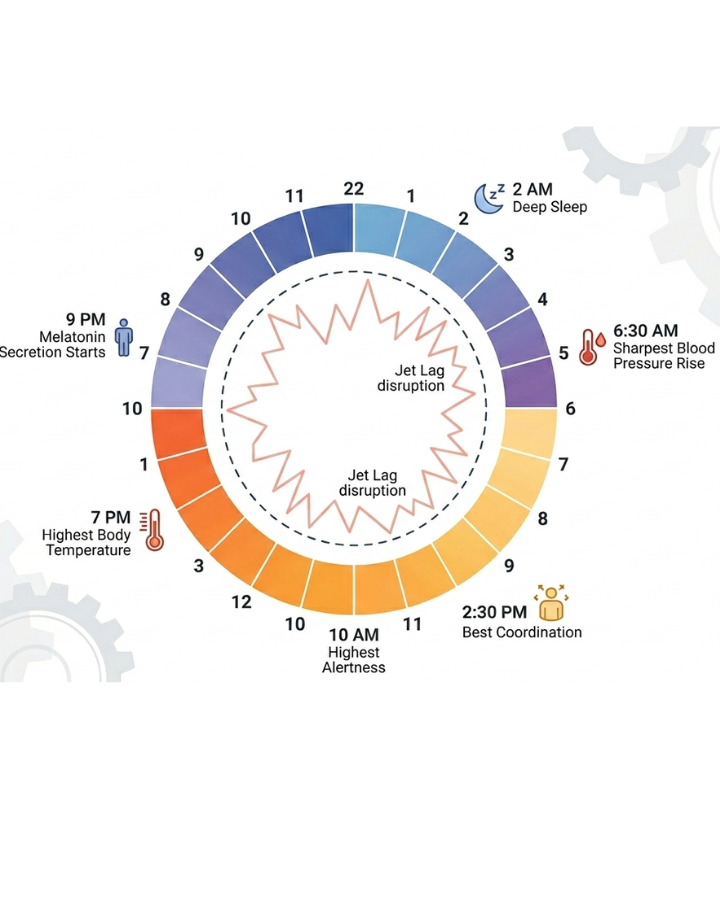
Here is a factor most people never consider. On a typical one to two week international trip, the outbound jet lag resolves gradually over the first few days. By day four or five, most travelers feel reasonably normal in their destination time zone. But for shorter trips or trips involving major time zone crossings, the circadian system may not have fully re-entrained by the time the return flight departs.
The NIH research paper on jet travel circadian schedules models this explicitly with a scenario called Henry’s round trip, showing that when the return trip begins before full re-entrainment at the destination, the clock arrives at the new destination (home) already in a partially misaligned state, then must make another large shift. The second shift requires the clock to advance again, in the same hard eastward direction, from a starting position that was already not quite settled. This stacking of unresolved first-leg misalignment onto a new second-leg misalignment explains why some people feel worse after returning from a two-week trip than they would have felt after the outbound flight.
This also explains a phenomenon frequent travelers report: very short trips, three to four days, can produce the worst return jet lag of all. The body barely began adjusting to the destination before it had to adjust back, and both adjustments were in the hard eastward direction. The result can be a week of serious sleep disruption at home from what was ostensibly just a brief visit.
The following table shows why the biological and psychological conditions at the start of the return trip are so different from those at the start of the outbound trip.
Factor | Outbound Flight | Return Flight (Home) |
Travel direction | Usually westward (US/Canada to Europe/Asia) | Usually eastward (Europe/Asia back to US/Canada) |
Clock shift required | Phase delay (natural direction, easier) | Phase advance (against natural drift, harder) |
Adjustment speed | ~1.5 hrs/day (CDC) | ~1.0 hr/day (CDC) |
Sleep debt at boarding | Rested, typically pre-trip normal | Accumulated 5-8+ hrs across the vacation |
Psychological state | Excited, anticipatory, adrenaline available | Trip over, relaxed, re-entry stress, no novelty |
External schedule at destination | Imposed by tourism (tours, meals, attractions) | Absent; must self-impose structure |
Antidromic risk | Lower on westward direction | Higher; especially with 8+ time zones east |
Prior circadian disruption | None; starting from home baseline | May not have fully resolved from outbound jet lag |
Recovery pressure | Low; vacation allows flexible pace | High; work resumes, social obligations resume |
Not everyone experiences worse jet lag on the return trip, and the science explains this too. Timeshifter, the NASA-affiliated jet lag app, reports that approximately 25 percent of people have a circadian clock with a period shorter than 24 hours. These individuals are the chronotype equivalent of natural early birds. Their clock naturally runs slightly fast, drifting slightly earlier each day, so phase advancing for eastward travel actually aligns with their biology rather than fighting it. For them, flying home east is the easier leg, and the outbound westward flight is the harder one.
Similarly, people with strong morning chronotypes, those who wake up naturally early and feel their peak energy before noon, tend to find eastward jet lag milder than the average traveler. As Timeshifter explains, the circadian period and chronotype exist on a continuum, so individual variation in jet lag by direction is real. The conventional wisdom that eastward is always worse holds for the majority of people, but it is not universal.

The science also tells us which specific return journeys are the most brutal on the circadian system. The University of Maryland mathematical model of the SCN found that nine-hour eastward crossings are the worst category of all, even harder than twelve-hour crossings. This is the specific case where the phase advance required is large enough to be difficult but not so large that the clock can take the short route by going the other way (delaying all the way around instead of advancing a smaller amount).
Practically speaking, this is the classic transatlantic return: New York to London (five hours east) is hard but manageable. London to New York (five hours west) is genuinely easy for most people. But the PMC research paper on minimizing eastward and westward jet lag specifically models the Los Angeles to London return (eight hours east) as a particularly severe case, where antidromic re-entrainment is common and recovery takes the longest. The same applies to returns from Japan, South Korea, Southeast Asia, and Australia for travelers based in North America or Western Europe.
Return Route | Time Zones | Direction | Return Difficulty |
London to New York | 5 west | Westward | Mild. Clock delays naturally. 3-4 days. |
New York to London | 5 east | Eastward | Moderate. Phase advance needed. 5-7 days. |
Tokyo to LA | 17 west or 7 east | Westward (long route) | Moderate-hard. Westward but large crossing. 5-7 days. |
Beyond the circadian biology, there is a powerful psychological component to post-vacation exhaustion that is distinct from jet lag itself. Researchers call this post-vacation blues or post-travel adjustment syndrome, though it is not a clinical diagnosis. The combination of returning to work responsibilities, the emotional contrast between vacation freedom and regular life, and the literal loss of the positive experiences of the trip creates a temporary negative affect that compounds fatigue symptoms significantly.
A 2021 German study referenced in National Geographic’s travel reporting found that worrying about having jet lag actually intensified its symptoms, a nocebo effect where anxiety amplified the biological disruption. After coming home from a trip, the context is arguably more anxiety-producing than before departure: there is a backlog of emails, a pile of responsibilities, and the knowledge that you are supposed to be functional immediately. That expectational pressure makes the same amount of circadian disruption feel considerably worse because there is no buffer of vacation time to absorb it.
Understanding why return-trip jet lag is harder is useful, but what most people want is a plan for dealing with it. Here are the most evidence-supported approaches, organized by when to implement them.
This factor is harder to quantify scientifically, but travel medicine practitioners consistently acknowledge it, and experienced travelers describe it reliably enough that it deserves serious treatment. When you fly to a new destination, you have excitement, novelty, and anticipation working in your favor. These are not trivial psychological effects on physical function. Stress hormones like cortisol and adrenaline that accompany positive anticipation raise alertness, suppress fatigue signals, and make it far easier to push through discomfort and stay awake until local bedtime on that critical first night.
On the outbound leg of a trip to Europe, many travelers find they can stay awake through an entire busy day after landing despite flying overnight. The excitement of new sights, unfamiliar streets, different foods, and the energy of beginning a trip provides a genuine biological boost that masks jet lag symptoms effectively. Travelers on Rick Steves’ travel forums consistently report the phenomenon: I never get jet lag going to Europe because the adrenaline rush of starting a trip keeps me going.
Coming home, none of that is present. The trip is over. Work is starting again tomorrow. The familiar surroundings of home offer no novelty to stimulate alertness. The body relaxes, the cortisol drops, and the accumulated sleep debt and circadian misalignment that were partly masked by vacation energy suddenly have nothing to compete with. The resulting exhaustion feels disproportionately heavy not because the biology is dramatically worse, but because the psychological padding that softened it on the way out is completely gone.
Certain conditions produce particularly severe post-return jet lag that goes beyond the typical experience. These are worth knowing because they benefit most from aggressive pre-planning.
Very short international trips (under 4 days): These are the worst because the clock barely began adjusting outbound before it has to adjust back. For trips to Europe of three days or less from North America, many travel medicine practitioners recommend not adjusting at all during the trip, maintaining home-base sleep and meal schedules as much as possible, and managing alertness with caffeine and strategic napping. This approach prevents the compounding misalignment problem entirely, at the cost of some functional awkwardness during the trip. For a two-day business meeting, staying on home time is often the better trade-off.
Older travelers: Multiple studies confirm that travelers over 60 experience circadian changes that make it harder to recover from jet lag. The Cleveland Clinic notes that some research also finds older people are more susceptible to the effects of circadian disruption generally. Older travelers should plan on one to two additional recovery days and may benefit most from the pre-flight adjustment strategies.
Eastward crossings of 8 or more time zones: As documented in the NIH antidromic re-entrainment research, crossings of eight or more time zones east have a high probability of the clock shifting in the wrong direction. These are the return trips from Japan, South Korea, Southeast Asia, and Australia for North American travelers, and from the US West Coast to Europe for European travelers. These journeys benefit most from jet lag calculators like Timeshifter that prescribe precisely timed light avoidance and melatonin to prevent antidromic re-entrainment.
After going deep into the research for this article, the most useful reframe I can offer is this: the return trip is not just the same journey in reverse. It is biologically harder, physiologically, it hits you with six distinct compounding disadvantages simultaneously, and it happens at the worst possible time when the psychological cushion of vacation excitement is gone and real-life pressure is immediate.
The single most practical thing you can do about it is to build one buffer day into your return. Fly home two days before you need to be fully functional, not the evening before. That one scheduling decision costs you one vacation day but buys you a recovery day to implement light exposure, proper sleep timing, and melatonin strategy without the simultaneous pressure of performing at work. For major crossings of six or more time zones, it is worth every minute of the lost travel time.
The second most useful thing is to start pre-adjusting two days before you fly home. Go to bed and wake up one hour earlier each of the last two nights of your trip. Get morning light at your destination on those mornings. It costs almost nothing and meaningfully reduces the clock misalignment you arrive home with. Most travelers ignore both of these strategies entirely, then spend a week feeling terrible and wondering why the return is always so much harder. It does not have to be.