
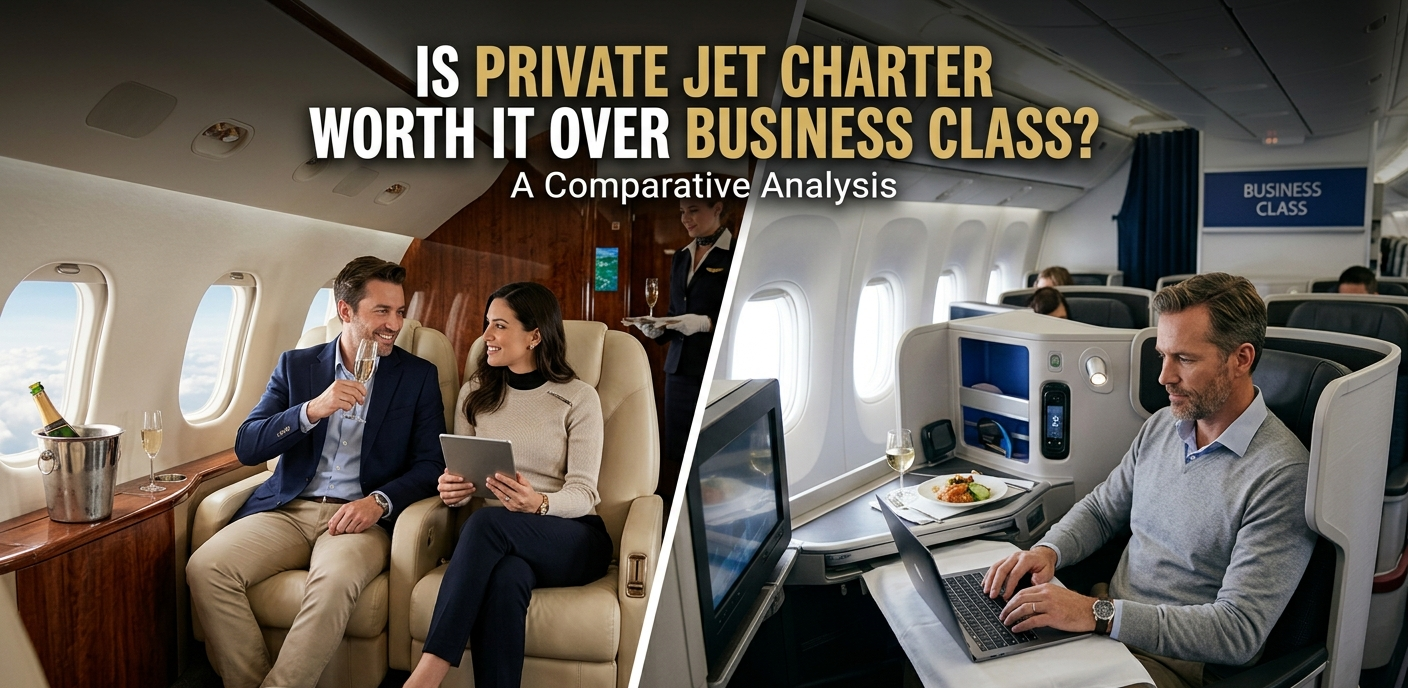
The honest answer
For a single passenger flying Sydney to Melbourne, business class wins on cost. Every time. A private jet charter on that route starts at around AUD $10,500 for the whole aircraft, versus roughly $800 to $2,400 per seat in business class on a commercial flight.
But that is not the whole question. The real question is whether private jet charter is worth it for your specific trip, your specific group size, and your specific set of circumstances. On that question, the answer changes depending on three variables: how many people are travelling, how much your time is worth, and where you actually need to go.
This article gives you the numbers to run that comparison yourself for any Australian route, along with an honest account of where each option genuinely wins.
Cost comparison by route
The figures below compare a private jet charter (full aircraft, light jet unless otherwise noted) against typical business class fares for the same route for multiple passengers. All figures are in AUD inclusive of GST. Charter rates are indicative; business class fares are approximate market rates and vary by airline, booking lead time, and season. For detailed charter pricing, see the private jet charter cost guide.
Select a route to compare
Tap a route to see the cost breakdown and per-passenger comparison.
Per pax at 4 travellers: $2,625
Flight time: approx. 1 hr 20 min
Airport: GA terminal, no queues
At 4 travellers: $3,200 – $9,600
Flight time: 1 hr 25 min + terminal time
Airport: commercial terminal
Per pax at 4 travellers: $3,250
Flight time: approx. 1 hr 30 min
Depart from GA terminal
At 4 travellers: $3,600 – $10,400
Flight time: 1 hr 35 min + terminal time
Commercial terminal, Brisbane Airport
Per pax at 6 travellers: $8,000 – $10,800
Flight time: approx. 3 hr 45 min nonstop
No connection, no overnight
At 6 travellers: $10,800 – $27,000
Direct flights available, approximately 4 hrs
Commercial terminal both ends
Per pax at 5 travellers: $5,200 – $6,800
Flight time: approx. 2 hr 30 min
Direct to Cairns, no connection
At 5 travellers: $6,000 – $16,000
Flight time: 2 hr 30 min direct
Commercial terminal both ends
Per pax at 6 travellers: $3,167 – $4,667
Direct to Hamilton Island Airport (HTI)
No connection, no transfer
At 6 travellers: $14,400 – $34,800
Total travel time: 4 to 6 hrs including transfers
Connection risk at Cairns or Brisbane
Per pax at 5 travellers: $3,200 – $4,800
Flight time: approx. 2 hr 10 min
Direct to Port Hedland, Pilbara
At 5 travellers: $4,500 – $11,000
Limited schedule options
Commercial terminal, PHE
What you actually get: the full experience comparison
Cost is one dimension. The experience of getting to your destination is another. Here is how the two options compare across every part of the journey.
| Factor | Private Jet Charter | Business Class |
|---|---|---|
| Departure terminal | General aviation terminal Arrive 15 min before departure. No queues. | Commercial terminal Arrive 60 to 90 min before. Security and boarding queues. |
| Security and check-in | Under 5 minutes Dedicated FBO facilities. | 10 to 40 minutes Varies by airport and time of day. |
| Departure time | You choose The aircraft waits for you, not the other way around. | Fixed schedule Limited to airline timetables. |
| In-flight privacy | Complete Cabin is yours alone. Confidential conversations possible. | Limited Adjacent passengers, shared cabin even in suites. |
| Cabin space per person | Significantly more Full cabin for your group. | Allocated seat Flat bed on long-haul; seats on domestic. |
| Meeting and working | Ideal Face-to-face table seating, whiteboard, complete privacy. | Limited Individual seats; group meetings are not possible in-flight. |
| Luggage allowance | Generous Varies by aircraft but typically well above commercial limits. | Fixed allowance Generally 2 checked bags plus carry-on. |
| Catering | Fully customised Pre-ordered to your specifications. | Fixed menu Business class menus vary widely by airline. |
| Airport access | 400+ airports nationally Including regional strips commercial airlines cannot reach. | Major airports only Commercial routes to capital cities and select regionals. |
| Delay and cancellation risk | Very low No network disruption. Aircraft is dedicated to your trip. | Higher Subject to airline network delays, weather holds, and rebooking queues. |
| Pet travel | Usually permitted in cabin Subject to aircraft type and operator policy. | Cargo hold only No pets in business class cabins on Australian domestic routes. |
| Single-passenger cost | Much higher Full aircraft cost regardless of how many fly. | Much lower Pay per seat only. |
| Earn frequent flyer points | Generally no Charter flights do not typically accrue airline points. | Yes Points accumulate on commercial bookings. |
| Status credits | No | Yes Commercial business class earns airline status credits. |
The time value calculator
Private jets save real time. Enter your details to see what that time is worth for your group.
At 12 trips per year with 4 passengers at $500/hr, your group recovers an estimated AUD $60,000 in productive time annually by flying private. Weigh this against the premium over business class to assess the true cost difference.
Time savings are estimates based on typical door-to-door comparisons for Australian routes. Actual savings vary by airport, traffic, and individual circumstances. All values AUD.
Breakeven calculator
Enter your route details to see at what passenger count private jet charter becomes cheaper per person than business class.
Per-passenger cost comparison
Enter your charter quote and business class fare to find the crossover point.
When business class wins
There are situations where business class is the objectively better choice, and being honest about that is how you make the right decision.
Business class is better when:
- You are travelling solo or as a pair
- Your route has frequent direct commercial services
- You want to earn frequent flyer points or status credits
- The charter premium over business class is more than 40 percent per person
- You have a flexible schedule and no time urgency
- Your destination is a major airport well-served by commercial airlines
- You are on a long-haul international flight where lie-flat beds are the priority
- You need to change plans frequently and want easy rebooking
Private jet wins when:
- Four or more people are travelling together
- Your destination is regional or remote
- Schedule control is critical to the trip
- Confidentiality matters during the journey
- You need to conduct a working meeting in the air
- Connection risk would cost more than the charter premium
- You are travelling with pets or specialist equipment
- Door-to-door time is genuinely worth paying for
The routes where private charter almost always wins
There are specific Australian routes where the commercial alternative is so inconvenient that the cost comparison becomes almost irrelevant. These are the situations where private aviation is not a luxury but a practical necessity.
Remote and regional destinations
Australia has more than 400 registered aerodromes, according to the Department of Infrastructure. Commercial airline business class reaches only a fraction of them. If your destination is a cattle station, a mining site, a remote island, or a regional township without regular jet services, private charter is not competing with business class. It is the only option.
Hamilton Island and the Whitsundays
Getting to Hamilton Island by commercial aviation requires a connection through Brisbane or Cairns. Private jets fly direct to HTI. For a group of five or six people, the charter cost is competitive with connecting business class fares, and the experience difference is significant. This is one of the clearest examples in the Australian market of where private makes obvious practical sense.
Pilbara and Kimberley mining routes
Resources companies running FIFO operations to Port Hedland, Karratha, Derby, or remote mine sites face limited commercial schedules. A delayed flight means delayed operations. Private charter gives mining operators schedule certainty that commercial aviation cannot provide. At the executive level, the per-person cost comparison with business class often favours charter once the full group size is counted.
Same-day return trips
If you need to fly to a city for a morning meeting and return the same afternoon, the first commercial flight out and the last flight back may not align with your schedule. Private charter departs when you need it to, which can convert an overnight trip into a same-day return, eliminating hotel costs, lost evening time, and the disruption of an extra night away from home or office.
If your route aligns with an available empty leg repositioning flight, the cost comparison changes significantly. Empty leg discounts of 40 to 60 percent off standard charter rates can make private aviation cheaper than business class even for two or three passengers. See the guide to empty leg flights in Australia to understand how to find and book them.
Who should fly which
Corporate executive (solo traveller)
Business classFlying alone, frequently, on commercial routes between capital cities. Points, status, and lie-flat beds on longer routes all make business class the right choice at this travel profile.
Management team (4 to 8 people)
Private jetA group moving together for a board meeting, site visit, or conference. Per-person cost becomes competitive, the meeting continues in the air, and the group arrives together without commercial terminal delays.
Mining and resources operator
Private jetFIFO movements to remote sites where commercial aviation does not reach, or where schedule certainty is operationally critical. Private charter is often the only viable option regardless of cost.
Leisure group (family or friends)
Depends on group sizeAt five or more people heading to a destination like Hamilton Island or the Whitsundays, charter can be cost-competitive while delivering a dramatically better experience. For smaller groups on commercial routes, business class wins on price.
International long-haul traveller
Business classFor most Australian travellers flying to Europe, the US, or Asia, business class lie-flat products on Qantas, Singapore Airlines, or Emirates deliver outstanding comfort at a fraction of the cost of a heavy jet charter. Private makes more sense for regional international routes where fleet availability is stronger.
Travelling with pets
Private jetAustralian commercial airlines require pets in the cargo hold on domestic routes. Private jet charter allows pets in the cabin on most aircraft, subject to operator policy. For pet owners, this is often the deciding factor regardless of cost.
How to decide: a step-by-step framework
Rather than guessing, run through these six steps for any specific trip. The answer will usually be clear by step four.
Charter is priced per aircraft. The more people sharing the cost, the more competitive it becomes. Start here before looking at any prices.
Multiply the one-way business class fare by the number of passengers. Include lounge fees, checked baggage, and any seat upgrade costs. This is your commercial benchmark.
Request a firm all-in quote from a CASA-certified operator for your exact route and date. Ask for the total inclusive of landing fees, crew, fuel, and catering. Use the charter marketplace to reach multiple operators efficiently.
Include ground transport to the terminal, check-in, security, boarding, flight, deplaning, and ground transport at the other end. Private typically saves two to three hours on short domestic routes. Multiply time saved by your effective hourly rate and your passenger count.
Before committing to either option, check whether an empty leg is available on your route and date. A well-timed empty leg can make the private jet cheaper per person than business class even for smaller groups.
Does the commercial route require a connection? Is your destination served by commercial airlines at all? Does the timing of commercial flights work for your schedule? These factors often settle the question before cost even enters the equation.
For more detail on how the different private jet categories affect cost and range, the aircraft size guide covers every category from turboprop to ultra-long-range.
Frequently asked questions
See what charter costs on your route
Get indicative quotes from CASA-certified Australian operators and brokers. No commitment, no pressure.
Explore the charter marketplace